Workflow and measurement
How to reduce appointment no-shows: 10 fixes, in the order to try them
Most no-shows aren't rude. People forget, can't find an easy way to cancel, or booked so far ahead that plans changed. That's good news, because each of those has a fix. Here are ten, ordered from the cheapest and most reliable to the ones you should add only after the basics work.
What is the fastest way to reduce no-shows?
Confirm every booking, send a two-way reminder about 24 hours before, and make cancelling or moving as easy as a one-letter reply. Then nudge unconfirmed visits on the day and refill freed slots from a waitlist.
| Fix | Cost | Why it works |
|---|---|---|
| Confirmation at booking | Free | Puts the date in writing and shows how to change it |
| Day-before reminder | One text | Clinic studies: no-shows fell from 21% to 15% with text notifications |
| Reply C / R / X | Included in two-way tools | Turns silence into confirmed, moved or freed |
| Same-day nudge (unconfirmed only) | One text | Multiple notifications beat a single one |
| Waitlist refill | Staff time | A refilled late cancel costs almost nothing |
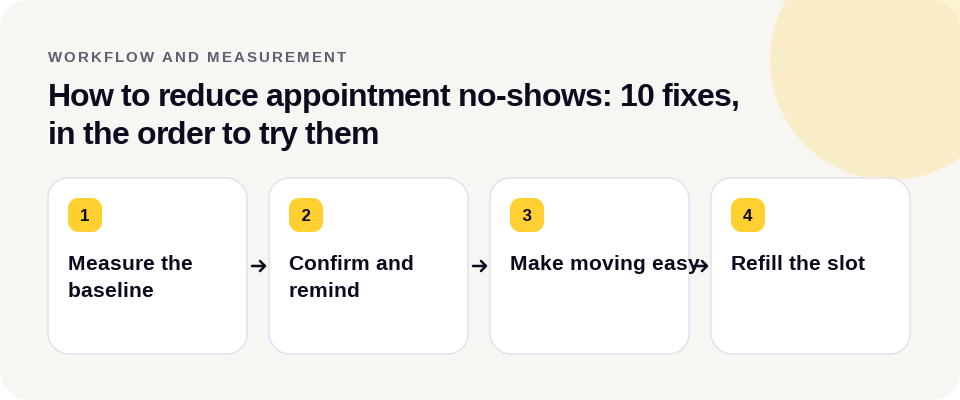
Start by measuring your no-show rate
You can't tell whether a fix worked without a baseline. Take the last four weeks of bookings and count only the visits still booked at your cancellation cutoff, for example 24 hours before. Divide the no-shows by that number. Count late cancellations separately: they hurt, but you can sometimes refill them.
Write down three numbers: no-show rate, late-cancellation rate and how many of those slots you refilled. The no-show cost calculator turns them into money, so you know how much effort the problem deserves.
1. Confirm every booking the moment it's made
A booking confirmation is the cheapest no-show fix there is. It proves the booking exists, puts the date and time in writing and tells the client how to change it. Send one after every booking and every change, never just the first one.
2. Send a reminder the day before
A text about 24 hours before the visit is the single most effective step. In a meta-analysis of 21 randomized clinic studies, patients who got text notifications missed 15% of appointments versus 21% for those who got none, a 25% relative reduction. Those were healthcare clinics; your effect may differ, which is why you measure.
Maple Studio: Hi Alex, a reminder of your appointment Tue, Dec 8 at 2:00 PM. Reply C to confirm or R to reschedule.
3. Ask for a reply, and make the reply do something
A reminder that asks "Reply C to confirm" does two jobs: it reminds, and it sorts your visits into confirmed and unconfirmed. That only works if a C actually marks the booking confirmed and an R or X reaches someone who can act on it. If replies land on a send-only number, leave the request out and give a phone number instead.
4. Make cancelling easier than not showing up
Many no-shows are cancellations that were too awkward to make. A client who would have to call during working hours, wait on hold and explain themselves will often just not come. A reply keyword or a booking link that works on a phone in two taps turns that no-show into a late cancellation you can refill.
5. Nudge unconfirmed visits on the day
Send a short same-day message, about two hours before, only to clients who haven't confirmed. Confirmed clients don't need it, and skipping them keeps your messages from feeling like spam. Multiple notifications improved attendance more than a single one in the same meta-analysis.
6. Shorten the gap between booking and visit
Visits booked weeks ahead are missed more often because plans change. You can't always shorten the lead time, but you can add an early reminder three to seven days before for far-out bookings and ask for a confirmation then, while there's still time to rebook.
7. Keep a waitlist and refill freed slots fast
A late cancellation you refill costs almost nothing. Keep a short list of clients who want an earlier time, and when a slot frees up, offer it to one person at a time with a short expiry so two people never get the same slot. The waitlist guide covers the details.
8. Give clear directions and arrival details
Some no-shows are people who couldn't find you, or arrived at the wrong entrance and left. If you see "where are you?" calls, add one line of directions to the same-day message rather than another reminder.
9. Set a fair policy, and say it in advance
A cancellation policy works when clients hear about it before they book, and again in the confirmation. Deposits for long or high-value services, and a fee for repeat no-shows, are common. Apply the policy consistently, keep it in line with local consumer rules, and don't threaten fees in a first reminder; a calm line in the confirmation does more.
10. Follow up after a miss, and track repeat no-shows
Text the client the same day with an easy way to rebook. No blame, just a link. Then flag clients who miss twice, and ask them to confirm earlier or pay a deposit next time. A small group of repeat no-shows often accounts for a large share of the total.
Maple Studio: Hi Alex, we missed you today at 2:00 PM. Want a new time? maplestudio.com/b/4821
What not to do
- Don't send five reminders. Past three, clients mute you.
- Don't count a refilled slot as "no no-show". Keep the original outcome and record the refill separately.
- Don't change three things at once. Change one, wait two to four weeks, and compare with your baseline.
Frequently asked questions
How do you reduce no-shows and cancellations?
Confirm every booking, remind the day before, ask for a reply that actually updates the booking, make cancelling as easy as a text, nudge unconfirmed visits on the day, and refill freed slots from a waitlist. Add deposits or fees only after those basics work.
How do you reduce patient no-shows?
The same steps work in clinics: early and day-before reminders, a simple way to confirm or reschedule, and a same-day nudge for unconfirmed visits. A meta-analysis of 21 randomized clinic studies found text notifications cut no-shows by 25% compared with no reminders.
What is a good no-show rate?
There's no universal benchmark: it depends on your industry, how far ahead people book and your cancellation policy. Measure your own rate on visits still booked at your cutoff, then compare each change against that baseline.
Do appointment reminders reduce no-shows?
Yes, in the research available. In a BMJ Open meta-analysis of clinic studies, patients who got text notifications missed 15% of appointments versus 21% without, and multiple notifications worked better than one.
Should I charge a no-show fee?
Consider it for long or high-value services and repeat no-shows, after reminders and easy rescheduling are in place. State the policy before booking and in the confirmation, and apply it consistently.