Workflow and measurement
How to test whether appointment reminders reduce no-shows
Measure a reminder change with a controlled comparison, kept visits, and uncertainty rather than before-and-after guesses.
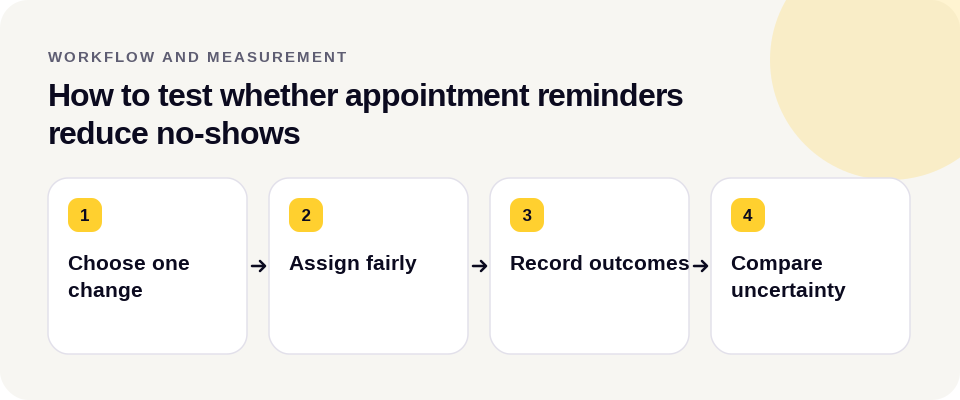
To estimate whether a new reminder makes appointments more likely to be kept, compare equivalent appointments served over the same period. A holdout does not have to mean sending no reminders: it is usually preferable to keep the existing approved workflow as the baseline and give the alternative to a separate group. Compare actual attendance under a definition set in advance, report group sizes, and check how much extra work the experiment created.
Pick one change and one primary outcome
A useful first experiment is “existing 24-hour reminder” versus “existing reminder plus a confirmation action,” or “a 48-hour confirmation” versus “a 24-hour confirmation.” If you change the channel, timing, copy and cancellation policy together, a result cannot tell you which part mattered. When choosing the baseline, do not remove essential safety or operational notifications. A different appointment type might not be an appropriate place to run the same experiment. Start on a category where both approaches are acceptable.
Specify the primary metric before assignment. One workable choice is kept visits divided by eligible scheduled visits, with a written decision on timely cancellation. Other useful outcomes include late cancellations, successful rebookings, customer complaints and staff workload. If reminders make it easier to cancel in time, no-shows may fall while the number of kept appointments stays flat; whether that's a business improvement depends in part on how often a vacancy is refilled. Classify all outcomes consistently instead of interpreting the headline in isolation.
Assign groups without letting the calendar choose
Avoid alternating half-months, putting difficult bookings in one arm, or rolling out the change only at your flagship site. Those choices mix the reminder with potentially important calendar differences. If you have a reliable random assignment mechanism, assign eligible appointments as they enter the study. If one customer has many appointments or might see both versions, assign by customer instead and keep that person in the same group. Keep the assignment in a place that cannot be overwritten by edits to reminder templates.
Light segmentation can help ensure useful balance where volumes allow. An example is assigning within location or within appointment type so one group does not accidentally contain all specialist appointments. Don't create dozens of tiny segments when you only have a few hundred visits. Record the inclusion rule, the assignment time, and the planned measurement window. If people are randomized before a booking is later canceled, state up front what your denominator will do; do not make that decision after seeing which cohort canceled more.
Count assignments even if delivery fails
Use the assigned group in the primary analysis. If an alternate reminder doesn't send because a contact address is missing, the rollout's actual effect includes that limitation. Looking only at delivered messages can bias the comparison toward customers who were easier to reach. Separately report delivery and suppression by group, so you can distinguish “the idea didn't help” from “many eligible customers did not actually receive the planned treatment.” Track accidental crossover and keep the raw events.
Make the outcome blind where you can. Staff should mark arrival, cancellation or no-show using a consistent appointment workflow without trying to prove the new reminder worked. Export outcomes after the grace period and note any unresolved rows. Before reading group results, inspect whether one location frequently leaves outcomes blank. Missing outcomes can change the answer, so report their magnitude rather than silently treating them as no-shows, or excluding only the inconvenient group.
Distinguish an attractive result from reliable evidence
Suppose the baseline has 200 bookings and 20 no-shows, while the new reminder has 200 bookings and 14 no-shows. The point estimate is a decline from 10% to 7%, a 3 percentage point absolute difference and a 30% relative drop. That looks promising, but a small difference among groups of that size can still be ordinary variation. Show the counts and calculate uncertainty with an appropriate two-group method, accounting for grouping if you assigned customers or locations instead of independent bookings. Do not claim statistical certainty based on the relative percentage alone.
A test may save money even if the headline effect is modest, or lose money despite fewer missed visits. Estimate the cost of the extra messages and staff minutes. Use a reasonable contribution per prevented loss, account for replacements already booked, and consider whether confirmation replies increased service burden. An apparent reduction of six fewer missed visits doesn't imply six additional sales at full price when some original slots would have been refilled anyway. Keep the calculation illustrative if you lack recovered contribution records.
Create decision gates before launch
| What you observe | Decision to consider |
|---|---|
| Better attendance with no material added burden | Roll out to the tested service, then monitor for sustained results. |
| Lower no-shows but more cancellations | Check eligible refills and total kept visits before changing all schedules. |
| Effect uncertain and volume limited | Continue only if the plan supports it; do not declare a win from a temporary fluctuation. |
Agree on what would justify stopping early, such as widespread incorrect reminders or customer confusion. Safety and support issues can override a statistical plan. For regular performance noise, do not stop the first week a dashboard happens to look favorable. Decide ahead of time how long the test will run and who can make the final call. Save the treatment copy and the criteria with the result so the next run can build on something observable instead of a remembered anecdote.
Record at least two guardrails before starting: complaints or opt-outs by group, and the number of replies requiring manual work. You could also measure median time spent by staff, but capture the proportion that exceeds the desk's target because one difficult exchange can tie up the person on duty. A version that slightly improves attendance while doubling urgent manual requests may not be an improvement. Document in advance which harms trigger a pause; resolve operational failures before restarting rather than silently replacing the version mid-test. If the new version materially changes after launch, treat it as a separate test and keep the two results distinguishable.