Workflow and measurement
How to calculate appointment no-show rate and cost
Measure kept visits, protect against denominator mistakes, and estimate the real contribution lost to missed appointments.
How do I measure the cost of missed appointments without counting appointments I rebooked?
Divide no-shows by the visits still booked at your cancellation cutoff, then cost only the slots nobody refilled. A rebooked client is future revenue, not a recovered slot. Keep the original no-show and record the rebooking separately.
| Step | Worked example (one month) |
|---|---|
| Booked visits | 220 |
| Canceled with 24+ hours notice (excluded) | 14 → eligible visits = 220 − 14 = 206 |
| Outcomes of eligible visits | 186 attended · 6 late cancellations · 14 no-shows |
| No-show rate | 14 ÷ 206 = 6.8% |
| Rebooked later | 5 of the 14 no-shows. Still counted as no-shows for the original slot. |
| Lost slots / refilled from waitlist | 14 + 6 = 20 lost · 3 refilled → 17 unrecovered |
| Gross revenue at risk | 20 × $85 = $1,700 |
| Unrecovered contribution | 17 × ($85 − $30 direct cost) = $935 |
Report the rate and the unrecovered contribution side by side. The gross figure is the ceiling, not your saving. Use the calculator below with your own numbers.
No-show cost calculator
Runs in your browser. Nothing you type is sent anywhere.
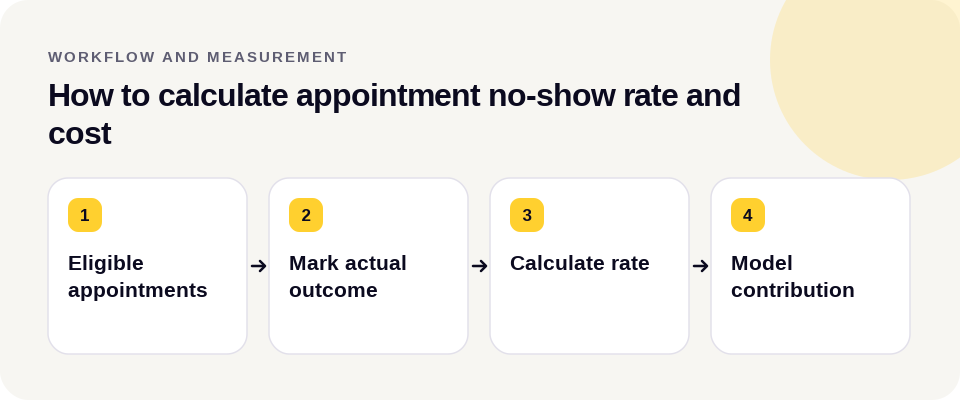
A no-show rate is the number of eligible appointments marked as no-shows divided by the number of eligible scheduled appointments in the same period. Multiply by 100 to express it as a percentage. For example, 18 no-shows among 240 eligible appointments equals 7.5%. That simple calculation is useful only if the shop uses consistent definitions and reports how many visits the percentage represents. Cost is a separate estimate: an empty slot does not always lose the full advertised price, and an appointment that staff filled from a waitlist may lose little or nothing.
Agree on what happened to each slot
Decide first whether the unit is the scheduled visit, the customer, or the slot in a room. A customer with two distinct appointments may count twice in a visit-based report. That is appropriate if missing two appointments created two gaps, but not if those two rows are two services under a single booking. Consolidate duplicate booking rows before calculation. Mark temporary holds, internal practice bookings, and test records ineligible. Keep an auditable mapping from booking record to outcome and do not edit historical rows just to make a chart look cleaner.
A kept appointment is one where the service was provided, even if the customer arrived late. A timely cancellation occurs before the cutoff your team decided it could reasonably use to refill a spot. A late cancellation is a separate event, not automatically a no-show. A no-show generally means no arrival by the defined grace period and no acceptable cancellation before the event. Apply the same definitions each week. Use a separate “awaiting outcome” category for closed days with incomplete data so these rows do not quietly become completed or missed.
Make a denominator that survives review
Suppose a studio had 300 booking rows. Remove 12 staff blocks, eight duplicate exports, and 20 timely cancellations under a policy that excludes them from the denominator. That gives 260 eligible appointments. If 16 were no-shows and eight were late cancellations, the no-show rate is 16 divided by 260, or about 6.15%. A separate last-minute disruption rate is 24 divided by 260, or about 9.23%. Someone who wants every genuine scheduled visit in the denominator may keep timely cancellations in it, but then they must state that definition and keep it consistent. Do not switch definitions from month to month.
Report the date window in service time, not booking creation time. An appointment arranged in October for a November visit goes into November attendance. Add a grace period after the reporting window to settle unresolved visits. If rescheduling creates a new row, classify the old row according to when the change happened and count the new visit in the window where it was scheduled. Do not count one kept visit twice merely because the original and revised times appear in the export.
Estimate the cost that matters
Start with expected contribution per comparable kept visit: price collected minus variable costs you would have incurred to deliver that visit. If the price is $80 and the variable expense is $12, expected contribution is $68. If a missed slot later recovered $40 of contribution from another customer, the residual loss is $28, assuming no missed-visit payment. A fee you actually collect can reduce the loss further, subject to your refund and cost treatment. Use net realized amounts rather than the invoice you hoped to collect.
A portfolio with 16 no-shows at $68 average expected contribution starts with $1,088 of potential contribution at risk. Suppose four of those slots were refilled for $60 contribution each and $75 in net fees were actually retained across the entire cohort. Estimated loss is $773. This is an illustrative calculation: do not apply the same average across a business with a $30 quick service and a $250 consultation without checking the mix. A separate customer-service metric can track complaints or repeat purchases; do not add speculative lifetime value to current-week loss.
Read the pattern before changing policy
Group missed slots by lead time, service, time of day and booking channel. For each group show eligible visits and misses alongside rate. Three misses in ten visits look worse than 21 in 300, but a small group can swing by ten points when just one person attends. Look for repeated differences over several comparable periods. Compare a particular service at similar times instead of merging a busy Saturday with a quiet Tuesday simply because both are mornings.
Test a change that fixes the pattern you observe. If most last-minute disruptions come from bookings made far in advance, try giving those customers an earlier confirmation opportunity. If the messages were sent but directions caused confusion, add an entrance cue rather than adding another reminder. If refills are common, monitor recovered contribution and staffing effort, not just the raw no-show rate. Document the planned change and its start date so future comparisons account for the change rather than attributing every subsequent shift to reminders.
Build a one-page owner report
Your owner report needs four numbers: eligible visits, no-shows, no-show rate, and unrecovered contribution. Underneath, show timely cancellations, late cancellations, refills, and incomplete outcomes as a reconciliation. Give each number a data owner who can drill down to dated booking records. A low rate can be expensive if it falls mostly on long, high-margin visits. Conversely, a higher raw rate in a low-margin service might be less urgent than a few unrecoverable misses on a bottleneck room.
| Review question | What to check |
|---|---|
| Did one person appear multiple times? | Count bookings by your agreed unit; group add-ons linked to the same visit. |
| Does a replacement erase a no-show? | No. Preserve the original outcome and record recovery separately. |
| Can I compare two different months? | Yes, if both periods use compatible definitions and their appointment mix is visible. |
Unrecovered contribution is a decision aid, not a guarantee of cash savings. Begin small: one export, one week, and a manual review of every disputed status. Hand a written example to the person who closes the desk and compare your classifications the next day. The consistency you gain from that conversation is usually more useful than an elaborate dashboard built on vague statuses.
Check your recovery list against actual room capacity. If another customer used the slot but paid for a shorter service, record the contribution that actually fit inside the time released. When the waitlist customer would otherwise have purchased the same service tomorrow, today's refill may shift demand rather than create an incremental sale. Keep that limitation visible in the owner report instead of estimating that every replacement was fully incremental.
Frequently asked questions
What should a missed appointment message say?
Keep it short and blame-free, and make rebooking one tap: "Maple Studio: Hi Alex, we missed you today at 2:00 PM. Want a new time? maplestudio.com/b/4821". Mention a no-show policy only if you have one and the client was told about it in advance.
How do you calculate a no-show rate?
Divide no-shows by the visits still booked at your cancellation cutoff (for example 24 hours before). Count late cancellations and refilled slots separately.