Copyable templates
SMS character counter and segment calculator for appointment reminders
The usual single-SMS limit is 160 characters in GSM-7 or 70 in UCS-2. A longer SMS generally uses smaller multipart payloads, commonly 153 GSM-7 characters or 67 UCS-2 units per segment, because the parts need reassembly information. These are common provider limits, not guarantees for every sender or destination. Measure a realistic rendered message using the tool your provider recommends before using segment counts in a price estimate.
Why is a 100-character appointment text billed as two SMS segments?
One character outside the GSM-7 alphabet, such as a curly apostrophe (’), an emoji or an em dash, switches the whole text to Unicode. A Unicode SMS fits 70 characters, and each part of a longer one fits 67, so 100 characters need two segments. Replace that character and the same text fits in one 160-character GSM-7 segment.
| Version | Message | Result |
|---|---|---|
| Curly apostrophe | Maple Studio: Hi Alex, you’re booked for Tue, Dec 8 at 2:00 PM. Reply C to confirm, R to reschedule. | Unicode (UCS-2), 100 characters, 2 segments |
| Plain apostrophe | Maple Studio: Hi Alex, you're booked for Tue, Dec 8 at 2:00 PM. Reply C to confirm, R to reschedule. | GSM-7, 100 characters, 1 segment |
| Template, short fields | Maple Studio: Hi Alex, a reminder of your appointment on Tue, Dec 8 at 2:00 PM. Reply C to confirm or R to reschedule. | GSM-7, 118 characters, 1 segment |
| Same template, long fields | Riverside Family Physiotherapy & Sports Rehab: Hi Christopher-Alexander, a reminder of your appointment on Wednesday, December 16 at 10:45 AM. Reply C to confirm or R to reschedule. | GSM-7, 181 characters, 2 segments |
Count the message after merge fields are filled in, not the template. A long business name or client name can push a 118-character template past 160.
SMS segment calculator
Estimates follow the GSM-7 and UCS-2 rules most carriers use. Some providers add a prefix or opt-out text, so check the final message as received.
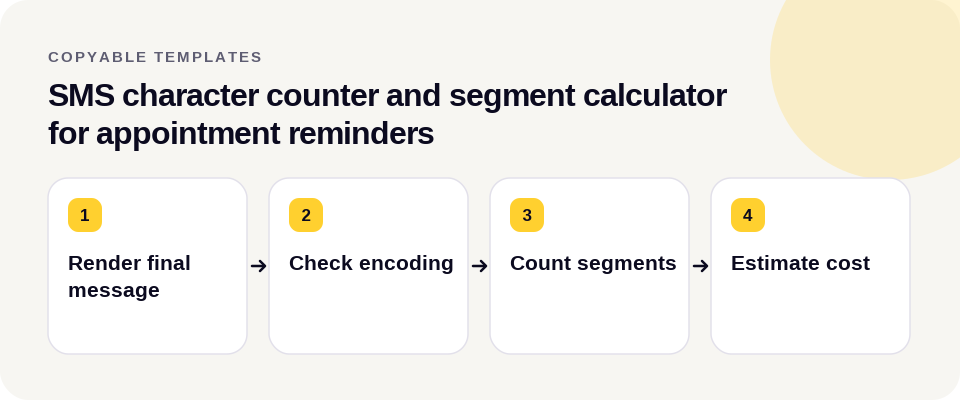
One visible message may be billed as several
A customer commonly sees the parts combined into one conversation bubble, but the delivery and billing systems can still handle several segments. According to Twilio’s SMS documentation, a GSM-7 message with 161 characters generally needs two segments; the first multipart segment holds up to 153 and the remaining characters go into a second one. This is not the same as switching the customer's display to a longer, differently priced email. Some senders or carriers may have additional limits, so inspect live test results instead of relying on the phone screen.
Unicode is a normal requirement when the language or symbols call for it. A single character outside GSM-7 can change the encoding of the whole string. Some visible glyphs need more than one unit, while some GSM-7 extension characters consume more than one septet. That means counting with a basic text editor or assuming a displayed glyph is one unit will occasionally understate the cost. The safer workflow is preview, inspect encoding, then verify actual billing.
Compact reminder you can adapt
Maple Studio: Your appointment is Fri, Mar 12 at 2:30 PM. To make a change, call 555-0108.
The example starts with a recognizable sender and uses short booking details with a contact route. It does not ask a customer to reply on a number unless that route is known to work. When substituting your business and branch, measure again. Avoid assuming the static copy length is the final length: a one-word studio name and a six-word multi-location label can produce very different previews. The same is true for any mandatory instructions appended by a configured service.
Add operational details only if needed
Maple Studio: Appointment Fri, Mar 12 at 2:30 PM, 16 East St. Use side door. To change it, call 555-0108.
The second example spends some of the space on address and entry rather than decoration. If one entrance is chronically missed, those words matter. If the address is long and the customer already has it in a booking email, point clearly to that detail or include an approved manageable link. Preview the actual substituted link because link lengths differ. Do not trade a trusted domain for an unfamiliar generic link merely to save a handful of characters.
Prefer straight punctuation where it is visually appropriate, but do not alter names or meaningful language just to fit a single segment. Remove "we wanted to take this opportunity to remind you" before removing a customer's accent mark or appointment zone. If a longer reminder is really necessary, accepting a second segment can be cheaper than managing a wasted visit. Email can carry supplemental preparation when your business uses both channels and can deliver them reliably.
Model cost with realistic distribution
Suppose 800 monthly reminders each use one segment, while 200 each use two. This hypothetical mix consumes 1,200 billable segments if charged by segment. At a hypothetical 1.5 cents per segment, that component costs $18, not $15 for 1,000 visible messages. This illustration is arithmetic only. It excludes number rental, compliance or registration fees, carrier charges, taxes, replies, marketing and any tier-specific allowances. Price from your provider's actual invoice or verified rate sheet.
For a more reliable budget, sample several kinds of booking: a short routine text, a first visit with a detailed location, a Unicode-language version, and a message carrying a confirmation link. Multiply each group by its actual monthly count, including reminders and updates if both are sent. Watch uncommon events after rollout; a batch closure, monthly event or new language launch changes the mix even if your template has not otherwise changed.
Preview the final rendered message
Check curly apostrophes and quotation marks pasted from a document; check the dash used as a separator; check a recipient whose name includes accents; check one real branch label at full length. Some platforms offer smart encoding or substitutions. Verify which characters can change and compare what customers actually receive. Do not let a bulk substitution alter people’s names, dates, business identities or otherwise impair readability.
Next, test a no-reply sender and a two-way sender independently if both are part of your operation. Their suffix and follow-up instructions may be different. A sending region may have its own route requirements or service constraints. Document your provider, route and test date alongside the template. Staff should be able to tell whether a revision last checked on a different sender still fits the route in use.
Fit the job, not the counter
Before shortening a draft, underline its four essentials: business, visit date, visit time, and workable next step. Then remove duplicated labels, cheerleading, and unnecessary sign-offs. If the existing route handles changes only by calling, say that; an impressive-looking "reply to update" costs more than it saves if it creates extra support work. A user-friendly title and brief action are more important than a rigid one-segment target.
Run your initial copy through the provider's calculator, send a controlled test, inspect the delivery log, and reconcile against one invoice or detailed usage export when available. Make the test repeatable. A content editor who copies a smart quotation mark or adds a friendly emoji should see the effect before paying for thousands of sends. Recheck after changing the sender, adding a language, or replacing long links.
When a one-segment policy backfires
A rigid target can push a team into using calendar shorthand that its audience misunderstands. For example, removing the time zone from a video appointment saves characters but can create an hour of confusion. Keep the information a recipient needs, then measure alternative channels. Compared with your accepted cost of a missed booking, paying for a second segment for a subset of messages may make sense. The point of the calculation is to choose consciously, not to force everyone into an identical template.