Copyable templates
Appointment Cancellation Message Templates That Clearly Release the Slot
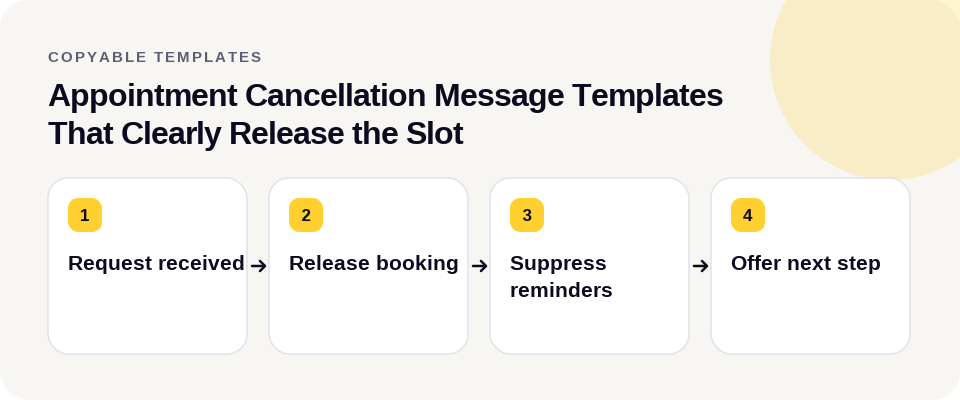
The best appointment cancellation message says which booking is affected, whether the slot has actually been released, and what happens next. Put the decision first. A person scanning a message on the way to an appointment should not have to read a paragraph of apology before learning whether to travel. Use compassionate language, but avoid terms such as "put on hold" when the appointment is finished.
When the client asks to cancel
Maple Studio: Your appointment Fri, Mar 12 at 2:30 PM is cancelled. You don’t need to come in. If you want a new appointment, use [booking link] or call 555-0108.
Send this once the cancellation is committed, not while a request is waiting for approval. If policy requires review, write "We received your cancellation request. We’ll confirm the status by [expected time]" and route it to staff. Add a clear contact method for anything time-sensitive. A stated turnaround is a promise to your reader, so choose one that the desk can normally meet.
If the same customer has several upcoming appointments, name the date, time and business or location; avoid a generic "your appointments were cancelled." A client cancelling one family member's visit should be able to see whether another is still on the calendar without revealing unnecessary information in the message. If several slots are cancelled intentionally, enumerate dates or write an honest series-level summary and provide a safe route to see details.
When the business cancels
Subject: Cancelled: your Fri, Mar 12 appointment at 2:30 PM
Hello [first name], we’re sorry: Maple Studio has cancelled your Fri, Mar 12 appointment at 2:30 PM. Please don’t travel to the studio for this visit. Choose a new time at [booking link] or call 555-0108 if you need help. No replacement has been booked.
If there is a short path to rebook with a known team member, include it. If a cancellation happens close to the start, a monitored call or other approved urgent contact may be more appropriate than trusting that a single email will be read. Give staff ownership of imminent exceptions. Where customers have different channels available, choose the route that fits their preference and your ability to act rather than blasting everyone indiscriminately.
An explanation can help when it changes what the customer should do, such as telling them a venue is closed rather than sending them to a different branch. Avoid sharing another person's private circumstances. A neutral "we can’t open the studio today" may be sufficient. If the venue remains open and only one worker is unavailable, avoid language that implies the building-wide closure.
Mention money precisely or defer it
Your appointment has been cancelled. We have recorded your refund request and will contact you at [expected time]. No replacement was booked.
"Refund requested," "refund issued," and "funds received" represent different events. Do not promise the customer's bank posting time unless you have a reliable basis for it. If a payment or deposit is relevant but unresolved, use the approved policy and give a specific support path. Never request full card details in a reminder thread. There may be different requirements depending on location and service, so the copy itself cannot determine whether a fee is permissible.
When the booking is clear but the payment is not, send accurate logistical information immediately; handle payments through a separate trusted interaction. If your ordinary messages include a booking link, ensure the cancelled appointment cannot quietly reappear as available to the customer through that link. Any payment history shown should be limited to the intended recipient and relevant record.
Remove reminders for the cancelled visit
The worst follow-up to a cancellation is a routine reminder for the same appointment. Disable future sends when the status changes. Make the delivery job check status again before dispatch, because the appointment can be cancelled between scheduling a notification and actually delivering it. A message already accepted by the provider may be beyond recall; monitor near-start cancellations so the correction reaches the customer in time.
Release inventory only when your cancellation workflow says it is free. If a manager is checking a request, do not send a waitlist offer and then discover that the original booking was kept. In systems that own both staff and room resources, release both correctly or no new appointment will be bookable. A named teammate should audit cancelled slots when the system is first deployed, especially after batch changes.
Plan a fallback for missed messages
A mail bounce tells you something different from a lack of reply. An undeliverable address or number should prompt a review of permitted contact channels, not an endless loop of retries. A same-day closure may call for designated staff to make a direct contact attempt. List what to do when you cannot reach someone, what notes to store, and where the desk can see recent attempts. This makes a later conversation less frustrating for the customer and the team.
If a customer says they will arrive anyway, respond with clear current status and an actual alternative rather than a copy of the automated cancellation. Have a safe way to look up the calendar without requiring them to repeat personal data in an ordinary text thread. For recurring schedules, explicitly cancel only the affected occurrence unless a customer requests the whole series to end.
Before the first live send
Test the customer-requested cancellation, business-initiated cancellation, old booking link, and an appointment with a separate sibling slot on the same contact. Check the calendar, staffed inbox, and outgoing queue after each. For a batch closure, first prove that the planned audience matches the affected location and times. Save one example the desk can read aloud so phone and text wording give the same outcome.
Avoid an accidental second cancellation
Use the original booking identifier internally for each cancelled notice, not a customer name and date typed into a message. This makes it easier to replay a failed notification without disturbing a replacement appointment or another member of the household. If your desk cancels a record in error, reinstate it only after checking that the old slot is still free and that the customer wants it. Send a corrected receipt that makes the current outcome explicit instead of ignoring the earlier notice.
Frequently asked questions
What do you say to cancel an appointment?
As the client, keep it short: "Hi, this is Alex. I need to cancel my appointment on Tue, Dec 8 at 2:00 PM. Sorry for the short notice." Add whether you'd like to rebook.
How do you tell a client you need to cancel their appointment?
Apologize, name the slot, and offer the next step in the same message: "Sorry, Alex, we have to cancel your Tue, Dec 8 2:00 PM appointment. Reply R and we'll offer the next open times." Then make sure no reminder for the old time goes out.