Industry playbooks
Salon appointment reminders: texts that protect chair time
Keep salon chair time booked with cut and color reminders, client-ready text examples, late arrivals, and a waitlist workflow.
What reminder sequence should a salon use for deposit-based color bookings?
Put the reminder that matters before your cancellation cutoff, so a client who can't make it still cancels in time for the deposit rules and for you to refill a long slot.
| When | Message |
|---|---|
| At booking | Confirms the service, length, stylist and deposit received, plus the cancellation policy |
| 48 hours before | Reminder with prep notes (arrive with dry, unwashed hair if needed) and the cutoff: "changes after Thu 2 PM forfeit the deposit" |
| 24 hours before | Reminder with Reply C to confirm or R to reschedule |
| 2 hours before | Only if unconfirmed: short nudge |
Maple Studio: Your color appointment with Sam is Sat, Dec 12 at 10:00 AM (3 hrs). Changes after Thu 10 AM forfeit the $40 deposit. Reply R to reschedule.
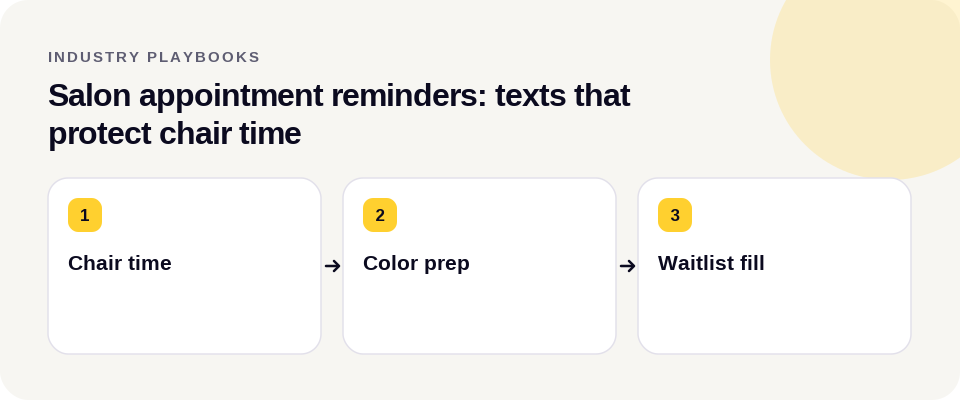
Build the sequence around the service, not one generic clock
A thirty-minute trim and a three-hour corrective color appointment should not inherit the same rule. The trim can usually be moved or filled from several directions. A color booking may reserve a stylist, assistant, chair, basin window, and processing time. In the booking form, give your service menu a simple tag such as Short, Extended, or Consultation. Use the tag to choose the sequence, not the client’s name, history, or whether they usually run late. Keep every message short, but send extended appointments far enough ahead that a real person can resolve questions without borrowing time from the next client.
For short services, try an initial booking confirmation followed by a day-before reminder. Add a day-of nudge only if it addresses a recurring issue, such as clients entering at the wrong door. For extended services, a reminder two days ahead leaves room to adjust the appointment length or clarify the agreed service. Check whether your business actually has coverage to answer replies then: sending at midnight before a Monday shift does not buy two productive days. Start with a rule your team can maintain rather than five different cadences you will forget to update.
Use one line for the service and one for the next step
Write the exact version of the appointment your customer booked. Do not relabel a consultation “your color appointment,” because that creates a reasonable expectation they will leave with color. The calendar should distinguish a guest’s booked service from notes about their preferred result. If a stylist wants a reference photo, send a separate instruction that explains where to upload it and when staff reviews it. Don’t ask guests to send pictures to a one-way number. The reminder succeeds when the guest knows where and when to arrive and how to ask for a change.
Review booking, advance, and edit messages as a sequence on one phone before turning them on. If every text repeats the service menu, policy, and arrival logistics, the guest will learn to ignore it. Say once which entrance to use; repeat it on the day only if it’s easy to get wrong. Say when a chair is available rather than implying the salon can fit in an extra treatment on arrival. Turn “Confirm your booking ASAP” into a direct request: “Reply YES to confirm, or call us to change the service.”
When one guest is running late, protect the next guest too
Put a real decision behind the late-arrival message. A stylist may be able to shorten a blow-dry but cannot promise a revised chemical process or finish time by text. Have the front desk ask for an ETA, check with the scheduled stylist, and reply with the agreed option. Keep three choices available to staff: original service if feasible, a clearly described reduced service if you both agree, or a new booking. Do not let an automation unilaterally infer consent from a guest replying “I’m coming.” A rescheduled guest needs explicit confirmation of their new time, not a generic “thanks.”
Staff often get tripped up by clients who are early for a later appointment while another client is late. Keep the queue view based on service start times and stylist names rather than message arrival order. If the system associates one mobile number with a family, check the booking before changing it. Copy the reason in a structured status such as “client called, rescheduled,” not as an open-ended history of what happened. For deposits or late fees, link the policy customers received when booking; avoid introducing a new rule in a reminder that arrives after the cutoff.
Fill the slot without double-booking the stylist
A waitlist can help only when the available appointment matches. Before offering the slot, check both duration and eligibility: a two-hour opening does not automatically fit every color request, and a client who can come on Thursday might need a different stylist. The simplest workflow is to offer the slot to one person for a specified period and log who has the active offer. If you notify a group, say that the first successfully booked customer gets the slot and that a text reply alone does not reserve it. Never imply the venue is holding the time for each recipient.
When a slot gets filled, release outstanding offers and send the new guest only their own appointment details. If the stylist is no longer free, use a short correction and offer a real alternative. Do not include the name of the client who canceled. Run a scenario during training where the original guest reappears just after a waitlist guest accepts. The front desk should have one shared calendar, a rule for which booking is valid, and a manager escalation route. Staff should not have to reconstruct the answer by reading all conversation threads with both guests.
Measure whether chair time is actually being recovered
Count extended services and short services separately. Look at unattended appointments as a share of eligible bookings, filled openings as a share of canceled slots you offered, and the number of replies left unresolved when a shift ended. A high “confirmed” rate is not the goal if a stylist still has an unusable forty-five-minute gap. After two comparable booking cycles, keep the message that creates actionable early responses and remove the one that only collects acknowledgments. Include a note about holidays, promotions, and stylist leave before interpreting a change.
Before the next color booking
Try a mock booking for a guest who selects a three-hour service, then asks to add a haircut two days later. The receptionist should find the initial booked length, ask the stylist what can still fit, and send a clear confirmation only after amending the schedule. Set a test cancellation close to the appointment and demonstrate that the waitlist receives only offers for the correct duration and skill. This takes longer than editing a text message once, but leaves you with evidence that a confirmed place actually matches availability. Check that replacing the appointment also releases the stylist’s auxiliary time, such as a basin or preparation block.
Frequently asked questions
What should salon appointment reminder software do?
Salon appointment reminder software should send a confirmation and reminders on schedule, show the service length and stylist, let clients confirm or reschedule by reply, and offer a freed slot to the waitlist without double-booking it.