Copyable templates
Recurring Appointment Reminders for Weekly and Monthly Visits
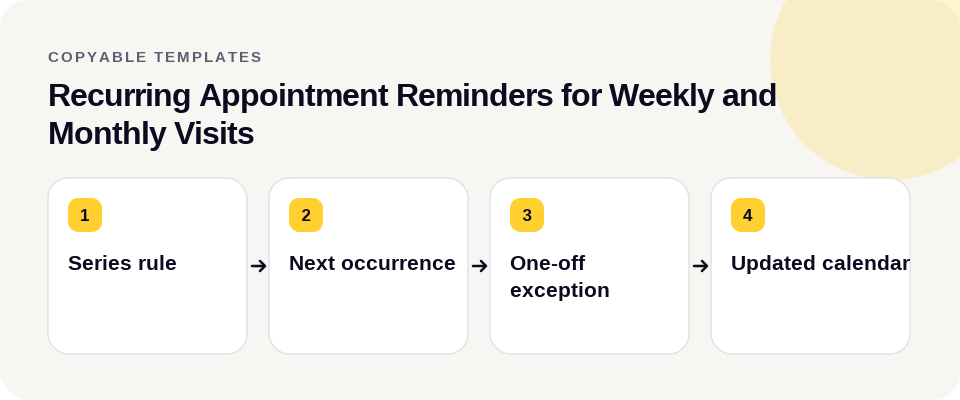
A recurring appointment reminder should highlight the next actual occurrence, not simply repeat the series pattern. A client might normally attend every Tuesday at 4 PM, but the message must say which Tuesday and whether this week differs. The series controls the usual rhythm; an individual occurrence controls what the customer is being asked to do today. In schedules with closures or substitutions, the distinction prevents mistakes on both sides of the desk.
Send a precise routine reminder
West Range Lessons: Your next session is Tue, Jun 8 at 4 PM at 52 Elm St. This is your usual Tuesday slot. Need to change this week only? Call 555-0124.
The reassurance about the normal slot is useful only if the event really uses the regular time. Identify the date even if the schedule is weekly. A delayed text that simply says "Tuesday" could mean this week's missed session or next week's upcoming one. Monthly dates also shift around short months and holidays. Read the current appointment record, not a plain text rule like "last Tuesday" that may not reflect a staff exception.
Cancel one date without cancelling the series
West Range Lessons: No lesson on Tue, Jun 8 because the venue is closed. Your regular slot resumes Tue, Jun 15 at 4 PM at 52 Elm St. Questions: 555-0124.
Give a resumption date only if it is confirmed. The closing note can make sense if it changes physical travel or access, but avoid unnecessary internal details about why an employee can't be there. Clear the queued reminder for the skipped event without deleting notifications for future dates. On a request to cancel "next week," confirm the exact date before changing anything if staff or customer might mean different weeks.
Handle one rescheduled event
West Range Lessons: This week's session moves from Tue, Jun 8 at 4 PM to Thu, Jun 10 at 5 PM. Your usual Tuesdays do not change. Questions: 555-0124.
For a time change, state which event is altered and whether the general schedule continues. Show venue changes even if the day remains the same. If a customer normally saves a repeating calendar event, they may leave Tuesday visible after opening Thursday's update; provide an honest guide to what your platform changes and what they should remove manually if necessary. Check that the new notification does not refer to an instructor or room assigned only to Tuesdays.
When every future occurrence changes
Subject: Your weekly session moves to Thursdays starting Jun 17
Hello [first name], starting Thu, Jun 17 your regular sessions are Thursdays at 5 PM. The Tue, Jun 15 session still meets at 4 PM. Location: 52 Elm St. Reply to this staffed inbox if this change does not work for you.
Name the final date under the old rule and the first date under the new rule. If the transition has a gap, mention it instead of assuming clients will infer it. When a whole program schedule changes, create a real staff route for replies from families who cannot attend. A schedule change might call for a different group, provider or place. Present these as options only if the team can actually offer them.
Decide who receives reminders
Some bookings have one point of contact for several people. Before sending personal details, confirm what the client asked the reminder service to disclose. If a parent receives two messages for separate sessions, differentiate those sessions with the least information needed. Do not assume replies identify the intended booking. An adult client may prefer to update their own contact preferences rather than rely on a group representative. Preferences should be attached to the right account or booking, not copied indiscriminately down a series.
For group sessions where all participants share the same schedule, an organizer notice may be enough if they have explicitly taken responsibility for distribution. For other operations each attendee needs their own route to cancel or ask for access. Avoid listing everyone in a shared notification. A recurring meeting invitation and an operational reminder may have different recipients, and the system should make those differences visible to the desk.
Build a reliable recurring model
Represent both the schedule and each actual occurrence. If staff often change a single event, identify that event in the reminder queue so retries cannot create duplicate notices. A cancellation or move should invalidate the old version of just that occurrence. If the regular day changes permanently, review whether reminders already queued for several future events need replacing. Keep a short log so a staff member can answer which notice belongs to which date.
Test in the time zone the customer is told to use. A client may travel and temporarily see a different device zone; show the region when useful, especially for remote sessions. Open a calendar invitation after a transition such as a clock change and compare the displayed time with the scheduling view. This is less about memorizing recurrence rules and more about proving that two systems agree on the next real appointment.
Set a light notification policy
A regular client may prefer a minimal reminder, while the first appointment or a change needs more context. Allow different advance notice for routine dates and exceptions where your workflow supports it. Distinguish an essential update from a routine reminder; do not send a new text every time a staff member makes an internal edit. If a recipient has several recurring visits, an optional summary can work for routine planning, but still send a timely explicit change when a specific booking is affected.
The initial checklist should include one holiday closure, one move, one scheduled rule change, one appointment after a clock change, and two recipients sharing a contact. Each test passes only if the customer can tell which date is affected and every remaining calendar event still matches reality. Check the next three occurrences rather than trusting the first example.
Document the difference between pausing and ending
A pause has an expected restart; ending a series does not. The copy should say which is true. If a pause has no firm return date, write that you will contact the customer by a specific date only if someone owns that follow-up. If the customer chooses to end recurring visits, do not automatically shift the entire series by one week as a workaround. Close future reminders and preserve the history of completed, skipped, and cancelled appointments.